The stages of development of HSS Life with Corona at the level of a territory
The HSS Life with Corona module is based on the HSS patent and the Blue Model, two innovations (one technical-health, the other economic) oriented towards “solution” that will allow us to respond to the current situation. Here are the phases encompassed by these strategies :
PHASE 1 : launch of the application
1.1 The development of the Life with Corona module, by the Foundation
Operation
We propose to develop this project urgently from the BlueWorld Foundation.
The HSS patent aims to prevent individuals in case of disaster and in a geolocated manner, it will therefore provide citizens who request it with an application with a set of features related to the different types of activated events.
Page 11 of the HSS patent (in annex), Fig. 3, presents a component architecture that will allow for the parallel management of several types of crises and enables communication with the citizen based on their location.
We propose to urgently develop the Life with Corona module for citizens (USER). References 2.1.1 & 2.1.2 & 2.1.3 & 2.1.4 represent the paragraph that contains the explanations.
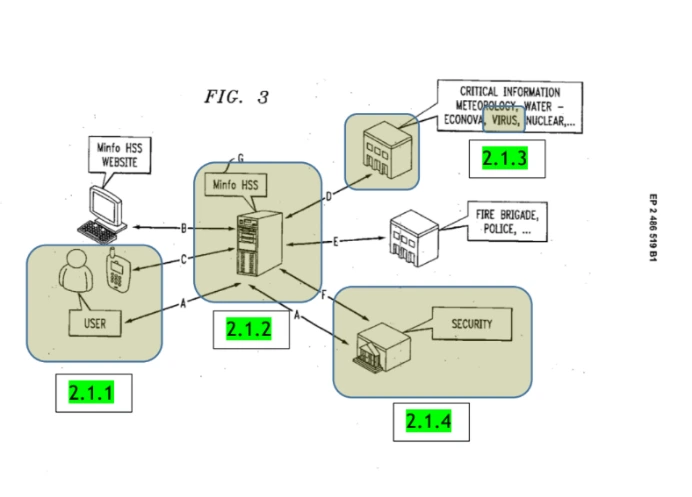
User interface (2.1.1)
Mobile application providing access to avoidance zones, via geolocation, and we could quickly integrate Bluetooth meetings in a second version.
Upon the first launch of the mobile application, there will be a precise presentation of the role of
the application, as well as an explanation of its functionality.
All guarantees will be explained and reinforced by the objectives of the BlueWorld Foundation, which is responsible for this development for citizens.
Then, the citizen moves to the next step and makes the following choice regarding their status:
– (1) Person with the COVID-19 virus (virus counter = 100).
– (2) Person who has been in contact with someone with the COVID-19 virus and is well (virus counter = 50).
– (3) Person who has symptoms of COVID-19 (virus counter = 50).
– (4) Person who is very well (virus counter = 0).
This selection gives direct access to the avoidance map centred on their geolocation.
There will be a counter for the number of people registered for the service and a counter of 0-100% of the potential viral state calculated based on their movements and encounters.
The avoidance map (calculated in 2.1.3) will show several types of zones:
– Grey zone (with depth of grey, increasingly darker depending on the density of the viruses)
– Yellow zone (type (2) and (3))
– White zone OK, no or no more virus (in relation to affiliations)
The mobile application will collect positions every 5 minutes and will send them to the server every hour or as soon as there is a network.
Potential viral infection counter information
Depending on the time spent in the zones and the calculated encounters, the counter will evolve (see calculation 2.1.3).
The user will then see their counter increase and will be able to react according to their state and
adapt the situation to match reality.
Despite this evolution, the counter can be adjusted by the citizen according to their state to 3 values: 0-50-100 and thus rectify the calculations.
If the person adjusts their counter to (0% or 100%), it is assumed that they have had a result and they will be asked how long they think they have been infected (in days).
This information will generate a correction of the map (see calculation 2.1.3)
When a citizen enters a zone, they receive information.
Office backup processing: Minfo HSS (2.1.2)
This central HSS module will contain all the layers (all the maps) received from the modules; initially, there will be 3 maps:
– The population density map
– The COVID-19 avoidance map calculated by the "Life with Corona" module
– The confinement zone map as well as the barrier messages between the zones
communicated by the "security" module.
This central module will manage access to the database containing all user (citizen) information and their geolocation over time in a secure database.
Module Life with Corona (2.1.3)
Creation of the COVID-19 virus map
This module will calculate the virus layer map.
Access to geolocation information occurs every 5 minutes, allowing for the calculation of the virus's lifespan and the creation of a 20 m zone around the geolocation point.
While moving, type (1) individuals leave a grey virus trace (with 50% transparency) with a virus lifespan of 12 hours, which will create the avoidance map.
While moving, type (2) or (3) individuals leave a yellow trace (with 50% transparency) with a virus lifespan of 12 hours, which will complete the avoidance map.
Over time, these zones will fade, and the traces will disappear.
After 12 hours, the trace has disappeared.
If a person's speed exceeds 20 km/h, the movement trace is not considered; they are then making a confined movement (by car).
Actions on the virus map related to modifying a potential viral infection counter
If a healthy person (4) or someone with doubts (2 or 3) crosses paths with a person with a virus and remains in an active zone for 1 hour, their counter will increase by 10.
If a healthy person crosses paths with someone with doubts (3 or 4) and remains in an active zone for 1 hour, their counter will increase by 5.
If a person has adjusted their meter, we will study the history of positions based on the number of days and see the registered individuals who may have been influenced to modify their meter and update the records according to the modification.
Internal Management
Depending on the reaction of the population and the actual situation, it will also be possible to adjust the parameters related to the speed of viral infection. This model could be supported by universities.
Interface the crisis department: module "security" (2.1.4)
The crisis department has the list of people responsible for managing this
interface. The crisis department will have access to the map and will be able to edit types of zones.
Type 1: Containment Zone
Type 2: …
For each type of zone, there will be recommendations
Citizens will see the zones and will have access to the recommendations.
Privacy Management (2.1.5)
Privacy management is the most important point, the application is a citizen service, geolocation is used solely for this service.
This geolocation will never be used to communicate information that is not requested, nor to sell a profile or use it for other purposes that have not been requested.
From a technical point of view, the module "security" (2.1.4) does not have access to the data but only to the maps to draw their maps to edit the type of zone and manage messages and recommendations.
The fact that the crisis department is outsourcing the development of the virus module to the BlueWorld Foundation will send a strong signal and all this credibility, it will be a major point of the product presentation to the citizens.
The BlueWorld Foundation subsequently wanting to develop for citizens a HSS mutual aid tool and an information management tool through a new kind of company, a Blue company, owned by the foundation 70% to ensure control of information management and privacy.
Building an economic response that puts man and nature at the centre of commercial transactions.
Also ensuring the benevolent use of information.
The BlueWorld Foundation will guarantee that it will not provide any information on
the geolocation of citizens to the state, the processing information for the crisis department will be purged of all data.
An ID without reference to any person with geolocation will be the basis of card management and will be used to present statistics and analyses.
1.2 Pilot Phase
The application will be put into production for a limited number of users to create a phase
pilot of 15 days in order to accurately size the necessary infrastructure based on
the complete local chain (mobile – telecom – provider – servers – DB).
This test will allow for the verification of all mechanisms and to correct and optimise the application if
necessary. It will allow for more accurate sizing of infrastructure and computing needs.
1.3 Deployment following the state's marketing strategy
As part of the project follow-up, this phase of communication through the media will allow the
communication of the application and the communication of the framework related to privacy.
A communication plan will need to be established to ensure an urgent dissemination of
the application while awaiting phase 2.
We will be able to show that this phase 2 is essential to increase the effectiveness of this
communication and the downloading of the application.
1.4 Project Management
Transparency and kindness are at the heart of the project.
Based on the requested resources, the foundation will purchase services from its technical partners
to develop the project at the cost of the administrative framework.
The foundation will use eRoom technology to monitor development and will use
funkitime technology to calculate the exact contributions of the partners.
These applications will be accessible by the project manager in the crisis department.
The budget for the application may evolve based on feedback and various
requests during the development.
PHASE 2: Development of the HSS Communication module
2.1 Deployment of the HSS web application
HSS web operation
Here is a video that explains the process related to HSS for a classic communication campaign:
We will create, in this phase, a WEB interface with the colours of BlueWorld.
https://youtu.be/rwgdyDQ5XtA
In this phase, we will create a web interface using BlueWorld's colors.
Foundation for the campaigns of the Life with Corona application and with the crisis department as a partner.
We will define a code (for example: CORONA) to be sent by SMS to the shortest possible number; if the crisis committee can obtain a 3-digit number for us, we will increase the effectiveness of communication.
This 3-digit number can subsequently be used for other campaigns that affect citizens (phase 4, 5, 6).
Sending the SMS will create a user environment on the Internet and directly deposit the documentation related to the Life with Corona application just one click away and allow for downloading.
Integration into the telecom network of the WEB HSS application.
This is the creation of a WEB interface for citizens, an interface based on their phone number without pre-registration.
This part of the HSS process will allow for increased communication effectiveness of the Life with Corona application.
This point corresponds to technically cabling the application with the operators on a dedicated phone number.
Each operator has a communication interface allowing for sending and receiving SMS over tcp/ip and thus enabling the return by SMS of the phone number to create a user environment.
The costs of the number and traffic will be borne by the State.
2.2 Deployment of this new communication with the crisis department.
The crisis department will be able to integrate this code related to the 3-digit number into all displays, communicate this in all news broadcasts, and at all press conferences.
PHASE 3: Analysis of results.
3.1 Recommendations based on citizens' movements.
The map will likely show significant virus concentrations; in these areas, recommendations will be directed towards those who do not move from these areas and probably towards traders.
To prevent the spread of contamination, it will be recommended to have masks at the heart of these areas.
3.2 Possibility of managing confinement more precisely
Some reflections:
The relationship with the population density map will provide sensitivity to the spread factor given its potential.
To prevent the spread, the confinement of these areas combined with the virus density could be interesting.
Bringing masks to these contaminated areas would therefore help reduce the spread of the virus by asymptomatic individuals.
As a result, the restart of the economy takes place outside of these areas.
On the other hand, crops will not wait for the end of the pandemic to rot on site…
It will be necessary to manage a precise de-confinement and allow access to the fields to harvest these crops.
For a gradual de-confinement
The status of individuals will be determined based on the areas:
– priority for those who can be active
– attention to at-risk individuals
Status of individuals prioritised to be active:
1. Healthcare workers, food sector, energy, transport
2. Immunised individuals – serological tests +
3. Teachers and students
4. Shops , Restaurants , bar, retirees
Status of at-risk individuals
• Those who had a positive serological test , low risk
• Those with a negative serological test , medium risk
• Retirees , high risk
Combined the 2 statuses to manage movements.
BLUEWORLD FOUNDATION
The Gate
Rue Fond Cattelain 2/2.2
1435 Mont-Saint-Guibert
Belgium
« Rely on technology while reinventing the economy » JLR
WHO ARE WE ?
Discover how we use technology to create a more humane and supportive economy.
Creation : Jean-Luc Rochet & Charlier.